
प्रोफ़ाइल
मुख्यपृष्ठ – Profile
Introduction
ICAR-National Research Centre for Makhana (NRC-M) was established in Darbhanga on 28th February 2002, considering the historical, cultural and economic significance of makhana in the Mithila Region of Bihar. To date, it is regarded as the only Research Centre in the world exclusively dedicated to makhana research. Its mandate was, however, expanded in 2023 to include research on lotus, water chestnut, fish and other aquatic crops with potentially high nutritive, medicinal, industrial and economic significance. During over two decades of its existence, NRC-M, Darbhanga, through its research and extension activities, has made an immense contribution in improving production, productivity of makhana, resulting in higher farm income, and area expansion, leading to establishing makhana as a superfood in the global arena. With a strong multidisciplinary team of scientists, newly acquired state-of-the-art scientific equipment, and research facilities/infrastructure, the NRC-M, Darbhanga, envisions further accelerating its research and extension activities for nationwide expansion of makhana cultivation. It also aims to develop cost-effective, easily adaptable technologies for makhana processing and value addition to better leverage India’s position as the world leader in makhana production and processing. The NRC-M, Darbhanga, remains committed to improving farmers’ income and livelihoods, and the agri-based economy of Bihar, Eastern India and beyond, through its demand-driven research and outreach activities. The major achievements are:
- The first ever improved variety of makhana “Swarna Vaidehi” was developed by NRC-M Darbhanga in the year 2013, with a production potential of 2.8-3.0 t/ha, almost double that obtained from conventional cultivation till then.
- The NRC-M, Darbhanga, initiated a field system for makhana cultivation requiring less water (30-45 cm water depth), nearly doubling productivity compared to traditional pond methods. Introducing makhana into this system has driven its quick spread to new areas and farmers.
- Makhana cultivation in cropping system mode was developed by NRC-M, Darbhanga, which allowed cultivation of as many as three crops in a year on the same piece of land, improving cropping intensity, land productivity and farm income.
- A system of makhana-cum-fish farming was also initiated. Vacant Space System for fish-cum-makhana cultivation and periphyton-based fish-cum-makhana cultivation was developed by the Centre.
- A package of practices for makhana cultivation, including nutrient management and crop protection measures, was developed by NRC-M, Darbhanga.
- The NRC-M Darbhanga has trained thousands of farmers and entrepreneurs in makhana cultivation, processing, value addition and marketing, which have yielded revolutionary results in terms of improving makhana productivity, farm income and makhana-based industries in north Bihar and beyond.
- In the past five years, the area under makhana cultivation in Bihar has increased from 13000-15000 ha to around 40,000 ha. Now the crop is being cultivated in many states other than Bihar, such as Chhattisgarh, Madhya Pradesh, Uttar Pradesh, West Bengal, Assam, Odisha, and Manipur.
- Two improved varieties of water chestnut, namely Swarna Harit and Swarna Lohit, have also been developed by the Centre.
- Research on lotus has also been initiated to explore its nutritional, medicinal, industrial and economic values.
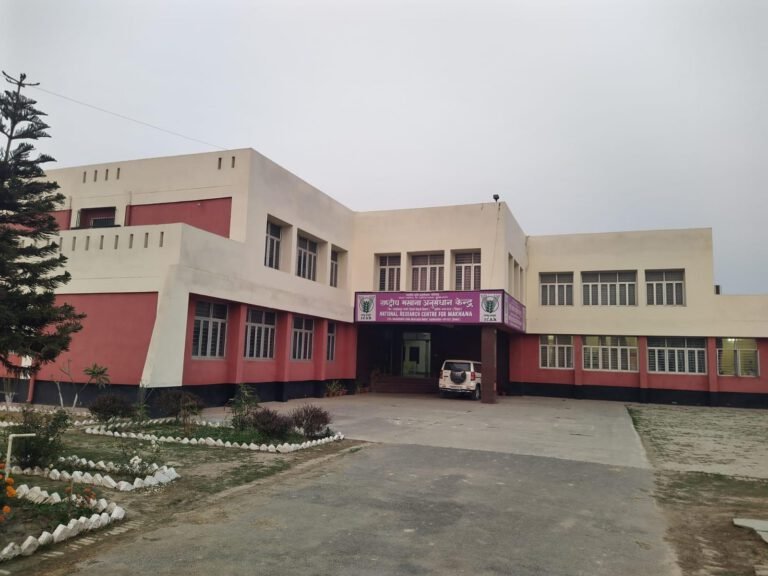
Institute building at ICAR-NRCM Darbhanga
जनादेश
Basic and strategic research for production, post-production and value-addition of makhana and other aquatic crops, including aquaculture
मिशन
To advance scientific research and sustainable technologies for makhana and aquatic crops, empowering farmers through innovation, knowledge transfer, and value addition.
विजन
To improve the livelihoods of all stakeholders in makhana and other aquatic crops through the application of appropriate mechanisation, production practices, biological improvements, standardisation, and management systems while ensuring health, nutritional security, and